
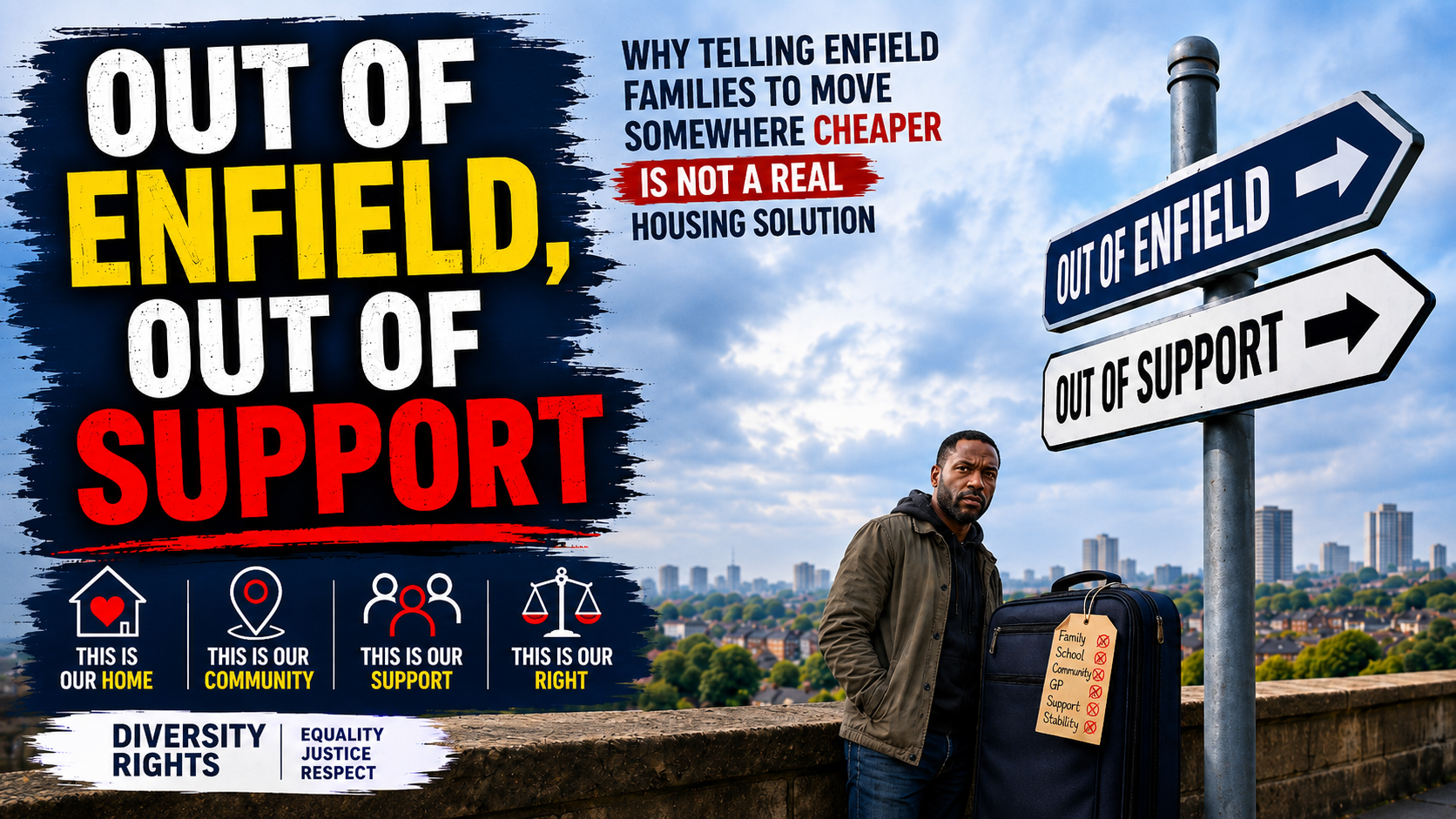
Why telling Enfield families to move somewhere cheaper is not a real housing solution
Introduction
Across Enfield, many residents facing rent increases, eviction notices or the risk of homelessness are reporting a troubling pattern. At the very moment they ask for help to remain stable, some say they are advised to leave the borough and look for private rented accommodation somewhere cheaper.
This article is based on Freedom of Information findings, interviews with people currently living in temporary accommodation or who have previously lived in temporary accommodation, and concerns raised by Diversity Rights (DR) service users. Together, these sources point to a serious question: is relocation advice being used as a practical housing option, or is it becoming a form of displacement for families who still have deep roots in Enfield?
At first, advising residents to look for cheaper areas may sound like practical affordability advice. Rents across Enfield and wider London remain far beyond what many low- to middle-income households can afford on Local Housing Allowance alone. Campaign reporting by Better Homes Enfield states that Enfield receives in the region of 400 new homelessness approaches each month, and that more than 3,000 households, including over 4,500 children, are living in temporary accommodation (Better Homes Enfield, 2026). Enfield Council’s own published placement policy acknowledges that because of the gap between Local Housing Allowance and local rents, accommodation offered to homeless households is unlikely to be in Enfield or even in London (Enfield Council, 2026a).
For families, however, moving away from Enfield is rarely a simple budgeting decision. It can mean losing the local support networks that make daily life possible. For Black, African, Caribbean, migrant and racialised residents, it can also mean moving into areas where there is no established community support and where they may face isolation, rejection, racism or discrimination.
DR believes that telling struggling families to move somewhere cheaper should not be treated as genuine homelessness prevention unless it follows a full, lawful, personalised and equality-aware assessment of the household’s circumstances. That requirement has not gone away now that the rules governing evictions in England have changed. If anything, it matters more.
The concern residents are raising
Residents tell us that when they face an eviction notice or other formal warning that their tenancy is ending, they are sometimes encouraged to look outside Enfield because local rents are unaffordable. Some experience this as advice. Others experience it as pressure.
The complaint is not that affordability should be ignored. Families understand the reality of high rents. Some residents who are in work say they would rather spend a high proportion of their income on housing in Enfield if it means staying close to family, remaining in a familiar environment, staying near the additional jobs many of them hold, or living in decent accommodation that supports their children’s wellbeing and educational achievement. The concern is that affordability may be treated as the only factor, while the rest of the household’s life is pushed aside.
A parent may ask what happens to their child’s school, who will help with childcare if they leave nearby relatives, how they will travel to work, whether they will still have access to their GP, what happens if their child has special educational needs, or what happens if they move to an area where they know nobody and may not be welcomed.
These questions are not emotional extras. They are central to whether housing advice is suitable, lawful, fair and sustainable.
Why moving from Enfield is not always a real choice
For many low-income families, the idea of housing choice is already limited. A household facing eviction may have no savings for a deposit, rent arrears caused by a benefit shortfall, difficulty passing affordability checks, limited English, a poor credit history, immigration-related barriers or direct discrimination in the private rented sector.
Research from the Resolution Foundation shows how wide that affordability gap has become. The shortfall between Local Housing Allowance and the cheapest third of local rents already stands at around 14 per cent nationally, equivalent to roughly 104 pounds a month for a typical two-bedroom home, and is forecast to reach a record 17 per cent next year (Resolution Foundation, 2025). London carries the sharpest end of that gap. In Hackney, for example, local rents on a two-bedroom property now outstrip Local Housing Allowance by around 350 pounds a month, the largest shortfall recorded anywhere in England (Resolution Foundation, 2025). Enfield sits within the same overheated London rental market.
When a household facing eviction is told to look for cheaper housing elsewhere, the advice may ignore the social infrastructure that makes daily life possible. Many Black, African, Caribbean, migrant and racialised residents rely on urban areas because similar communities are already established there, public transport runs day and night, and essential services are easier to reach, including schools, GP surgeries, advice agencies, faith groups, shops, employment opportunities and community organisations. For some families, these networks are not optional comforts. They are part of how people survive housing insecurity, low income, language barriers, discrimination and isolation.
Moving families to cheaper but unfamiliar areas can remove the very support systems that help them remain stable. A cheaper rent does not automatically mean a safer, fairer or more sustainable life.
What Enfield Council’s placement policy says
Enfield Council’s published placement policy for homeless households sets this out in plain terms. It states that Local Housing Allowance rates were frozen from 2020, and although they increased in April 2024, it is highly unlikely that the allowance will cover the full cost of renting in Enfield or wider London (Enfield Council, 2026a). Because the council can only place households where rent and Local Housing Allowance are reasonably matched, it confirms that the housing it offers is unlikely to be in Enfield or London at all.
The policy does recognise a small number of exceptions. A household is more likely to be kept within or near Enfield if a child is in their final year of GCSEs or A-levels, if the applicant is a registered carer receiving Carer’s Allowance for a family member who lives in Enfield, or if someone has a severe and enduring health condition that requires specialist care only available locally (Enfield Council, 2026a).
This matters for two reasons. First, it confirms that residents’ experiences are not isolated misunderstandings or the personal judgement of individual officers. Out-of-borough placement is, in many cases, published council policy. Second, it shows the council already accepts that some circumstances justify protection from relocation. DR welcomes that principle, but believes the list of protected circumstances is too narrow, and does not yet reflect the full range of factors that statutory guidance and case law require councils to weigh, including domestic abuse risk, disability, employment, mental health and the wider network of support a family depends on.
It would also be wrong to ignore the progress Enfield has made elsewhere. The council ended the use of hotels for temporary accommodation during 2025, and statutory figures for April to June 2025 show that 58.9 per cent of households it helped secured accommodation for at least six months, against a national average of 54.2 per cent (Enfield Council, 2025). That shows a more personalised, prevention-first approach is achievable. The question this article raises is whether the same care is being extended to the decision to send a household out of the borough altogether.
Relocation can turn a housing problem into social displacement
For many residents, relocation is not simply a move from one property to another. It can mean starting from scratch in an unfamiliar area, losing relatives who help with childcare, friends or family who take children to school when parents cannot, trusted community organisations, and local services that already understand their circumstances. Some Black, African, Caribbean, migrant and racialised households may also fear rejection, racism or discrimination in areas where they have no established community presence.
People do not live by rent figures alone. They live through relationships, routines, trust, local knowledge and support. A family that appears to be rehoused on paper may in reality have been disconnected from the networks that allowed them to cope, and when a household is already under pressure from eviction, debt, overcrowding or poor housing conditions, sending it to an unfamiliar area without careful assessment can deepen the crisis rather than solve it. The stress of repeated upheaval can also take a real toll on physical and mental health.
Over time, this can also change the social character of the borough. Lower income families are not only losing homes; they are being pushed away from the areas where they have built their lives, as communities that have contributed to Enfield for decades are gradually priced out, not because they want to leave, but because the housing system no longer protects their place in it. For children this can mean school disruption and loss of friendship networks. For parents it can mean losing informal childcare and employment. For older or disabled residents it can mean losing familiar medical services and trusted neighbours. Many of those being displaced are key workers, including drivers, care workers, cleaners, security staff, cooks and childminders, the very people Enfield and London depend on to function. For migrant and racialised communities it can mean being moved away from the areas where cultural identity, language support and community safety are strongest. This is not a small inconvenience. It is a serious community justice issue.
The legal landscape has just changed: from Section 21 to Section 8
For many years, the route into this kind of relocation pressure began with a Section 21 notice, the so called no-fault eviction notice that allowed a private landlord to end a tenancy without giving any reason. That route has now closed. Under the Renters’ Rights Act 2025, Section 21 was abolished from 1 May 2026, and the last date a landlord could validly serve a new notice was 30 April 2026. Almost all assured shorthold tenancies converted automatically into open-ended periodic tenancies on that date, and landlords have until 31 July 2026 to take any outstanding Section 21 case to court before that transitional route closes for good (Shelter England, 2026a).
From 1 May 2026, a landlord who wants to end a tenancy in England must use the Section 8 process instead, and must point to a specific, evidenced ground for possession, such as serious rent arrears, wanting to sell the property, or moving back in themselves (Shelter England, 2026b). This is a meaningful legal change. It removes a landlord’s ability to evict a tenant with no reason at all, and gives tenants firmer ground to challenge a notice that does not meet the required conditions. Helpfully, updated guidance also confirms that where a homelessness prevention duty arises because of a valid Section 8 notice, the council cannot end that duty simply because 56 days have passed if the household remains genuinely threatened with homelessness (Shelter England, 2026c).
The abolition of Section 21 is important, but it does not remove the affordability gap or the risk that residents are still advised to leave Enfield without a full assessment. Residents and advisers need to understand the new Section 8 grounds quickly, because advice that still assumes a Section 21 notice is in play will no longer reflect the law that applies to them.
Homelessness prevention must be personalised
Homelessness prevention should not mean simply advising residents to leave the borough. Under the updated Homelessness Code of Guidance, a person can be treated as threatened with homelessness if they are likely to become homeless within 56 days, whether that risk arises from a valid Section 8 notice, the end of a periodic tenancy, or another form of eviction risk (Ministry of Housing, Communities and Local Government, 2025).
Prevention should involve reasonable steps to help a household avoid homelessness. That may include early advice, negotiation with the landlord, support with benefits, rent shortfall assistance where appropriate, welfare advice, help with a deposit, and support to secure suitable accommodation. DR’s Freedom of Information findings indicate that Enfield Council did not provide recorded breakdowns of the underlying reasons why people approach it as homeless. Without that information, it is difficult to see how prevention work can be properly targeted at the causes of homelessness rather than only its symptoms (Diversity Rights, 2026).
Where relocation is considered, it must not be treated as a blanket solution. The suitability of housing cannot be measured by rent alone. The Supreme Court made this clear in Nzolameso v City of Westminster, ruling that a council placing a homeless household outside its own area must show it has properly considered factors such as the disruption to a child’s education and the distance from work, rather than relying on cost alone (The Supreme Court, 2015). Location, family circumstances, children’s education, health needs, employment, caring responsibilities, disability, safety and support networks all matter, particularly where the household includes children, disabled people, survivors of domestic abuse, people with health conditions, residents with limited English, or families from communities that may face racial discrimination in unfamiliar areas.
The risk of unfair and unequal impact
Advice to move somewhere cheaper may appear neutral, but its impact may not be equal. Black, African, Caribbean, migrant and racialised households may rely heavily on local community organisations, faith groups, language support, culturally familiar services, relatives and informal care networks. Women heading single-parent households may depend on nearby family members to work, attend appointments and manage childcare. Residents with limited English may depend on trusted local advice agencies to understand housing letters, benefits, school issues and council decisions.
If these factors are not properly assessed, relocation advice may have a disproportionate effect on the same communities already facing housing inequality. Public bodies must not only ask where rent is cheaper. They must also ask whether the move is suitable, safe and sustainable, whether it will protect a child’s education, preserve employment and caring responsibilities, and whether it risks isolation, discrimination or greater vulnerability. A prevention strategy that ignores these questions is not genuinely preventive.
Challenges facing residents and the council
The housing situation in Enfield is genuinely difficult. The borough faces high demand for homelessness support, limited social housing supply, high private rents and continuing pressure on temporary accommodation, all part of a national housing crisis. Campaign reporting by Better Homes Enfield estimates that more than 3,000 Enfield households, including over 4,500 children, remain in temporary accommodation (Better Homes Enfield, 2026), even as the council reports genuine progress on prevention and on ending the use of hotels (Enfield Council, 2025).
Residents are also facing serious challenges that should not be overlooked. Many private renters cannot find affordable homes in Enfield even when they are working. Some landlords refuse tenants receiving benefits or families needing larger homes. Families may not receive early enough advice when arrears or eviction risk first appear. Residents with limited English may struggle to challenge decisions or understand their rights. Black, African, Caribbean, migrant and racialised families may face discrimination when searching for private rented housing in unfamiliar areas. Families moved away from Enfield may lose childcare, schools, health services and community support. The danger is that pressure on the system becomes pressure on residents to leave.
What our Freedom of Information findings show
DR’s Freedom of Information work supports what residents are telling us. Enfield’s housing crisis is not only about affordability, but also about long waits, out-of-borough placements and unequal outcomes.
Our FOI analysis found that the average stay in Enfield temporary accommodation increased from 710 days in 2022/23 to 1,364 days in 2024/25, nearly four years (Diversity Rights, 2026). The data also showed households being placed outside Enfield, including in areas such as Herefordshire, Luton, Harlow, Dacorum and Inverclyde in Scotland.
This matters because advice to look for cheaper accommodation elsewhere does not exist in isolation. It sits within a wider housing system where many families are already spending years away from settled housing, and where some households are placed far from the borough, their schools, GPs, relatives and community support.
The FOI findings also raised equality concerns. Black/African households, using the ethnicity category recorded in the FOI data, were overrepresented among Enfield temporary accommodation residents with known ethnicity compared with their presence on the Housing Needs Register, and the data suggested that Black/African households on the register were less likely to receive permanent social housing allocations than White British households (Diversity Rights, 2026).
DR is not saying this data proves deliberate discrimination by Enfield Council. It does, however, show a serious and sustained disparity that requires explanation under the Equality Act 2010 and the Public Sector Equality Duty. The Council has said it does not hold the underlying breakdowns by priority band, household type or homelessness duty that would let it explain fully why these gaps exist. We have requested an internal review of the Council’s response, submitted further Freedom of Information requests, and will publish a separate, fuller article on temporary accommodation duration, out-of-borough placements, permanent allocation rates and ethnic disparities in Enfield housing outcomes as further data is received.
The national picture: Enfield is not alone
This is not solely an Enfield issue. A Guardian investigation reported in June 2026 found that London councils have been moving homeless families hundreds of miles away, in some cases unlawfully, and that ministers are now considering measures to restrict the practice (The Guardian, 2026). MPs quoted in that reporting described vulnerable people, including women fleeing domestic abuse, being effectively forced to choose between rough sleeping or accepting cheap housing in some of the poorest parts of the country. Separate reporting has documented families relocated more than 250 miles from London to areas such as County Durham, in one case a household who had recently been granted the right to remain in the UK and were driven north with no job and no school place arranged for their child, only learning of the move shortly beforehand (Homelessness Impact, 2026).
DR raises Enfield’s practice in this wider context for two reasons. It shows that the pressure driving relocation advice is structural and national, not simply the fault of individual officers working under enormous demand. But it also means that without a clear, published, equality-aware framework, Enfield risks becoming part of a pattern that government ministers are now actively examining for potential unlawful practice.
What good housing prevention should look like
A fair prevention approach would recognise affordability without reducing every household’s situation to affordability alone. Good homelessness prevention should include:
- A full written assessment before relocation advice is given.
- Consideration of children’s schooling, exams, special educational needs and safeguarding.
- Assessment of employment, health, disability, caring responsibilities and domestic abuse risk.
- Recognition of relatives, community ties, faith groups, language support and advice networks.
- Clear written reasons where a household is advised to consider moving outside Enfield.
- Support to negotiate with landlords, and clear advice on the new Section 8 grounds, before eviction becomes unavoidable.
- Advice on benefits, income maximisation, rent shortfalls and housing rights.
- A placement policy reviewed regularly so its exceptions reflect Nzolameso and domestic abuse risk, not only education and caring responsibilities.
- Monitoring of relocation advice and outcomes by ethnicity, gender, disability and household type where lawful and appropriate.
This would help ensure that relocation is not used as an easy answer to a complex problem.
Lived experience: what residents are telling us
A family facing eviction may be told to look outside Enfield because rents are cheaper elsewhere. But that family may rely on a grandmother nearby for childcare, or on a school that already understands their children’s needs. Without that support, what looks like a housing solution can quickly become an employment problem, or mean disrupted schooling and friendships at the worst possible time.
A tenant facing a Section 8 notice for rent arrears caused by a benefit delay can receive exactly the same out-of-area advice that a Section 21 tenant would have received a year earlier. The change in legal process can create a false sense that the underlying problem has been solved, when for many families nothing about their risk of being moved away has changed at all.
These experiences show why housing decisions must be made with people, not simply about properties.
Testimonials: residents in their own words
DR regularly hears directly from residents affected by this issue. The testimonials below were shared with our caseworkers and are reproduced with permission, with names changed to protect identity. These individual experiences do not replace official data, but they show how relocation advice can affect real families in practical and emotional ways.
“When the letter came, the advice was simple: look somewhere cheaper. But my mum is ten minutes away and she does the school run twice a week so I can work nights. If we go, I do not just lose a flat, I lose the person who keeps everything together.”
Sarah, Enfield resident, name changed to protect her identity
“I got a Section 8 notice instead of a Section 21, but the advice from the housing office was exactly the same as it would have been a year ago: go somewhere cheaper. Nobody asked about my daughter’s school, or that my church and my whole support network are here. We have lived in Enfield for 20 years and it felt like none of that counted.”
David, Enfield resident, name changed to protect his identity
Opportunities for Enfield
This issue also creates an opportunity for better local practice. Enfield Council, MPs, councillors, advice services and community organisations can work together to develop a stronger homelessness prevention model, involving earlier intervention, clearer communication, more transparent decision-making and stronger links with trusted local organisations.
DR believes voluntary and community organisations can play a constructive role by identifying patterns, supporting residents to explain their circumstances, helping families understand their rights, and feeding lived experience evidence into housing policy. If residents are being advised to leave Enfield, the borough should know how often this happens, who is affected, where families are advised to go, whether they actually secure stable housing, and whether the advice produces fair outcomes. Without this information, there is a risk that displacement becomes invisible.
What DR is calling for
DR is calling for a fairer, more transparent and more humane approach to homelessness prevention in Enfield. We believe Enfield should:
- Review how advice to move to cheaper areas is given to residents facing eviction, including under the new Section 8 process.
- Ensure relocation advice is never used as a default response without proper assessment.
- Publish clear guidance on how officers consider schooling, employment, health, family support, domestic abuse risk and community ties.
- Update the placement policy exceptions so they reflect the full range of factors required by Nzolameso and current statutory guidance, not only education and caring responsibilities.
- Explain, through a formal equality review, the gap our Freedom of Information analysis found between Black/African and White British households’ rates of receiving a permanent allocation, which had widened to at least 1.6 to 1 by 2025/26.
- Monitor whether relocation advice disproportionately affects Black and minoritised, migrant, disabled or single-parent households.
- Provide written reasons when residents are advised to consider moving outside Enfield.
- Publish data each year on how many households are placed out of the borough, how far, and what happens to them afterwards.
- Strengthen early intervention before households reach crisis point.
- Work with local community organisations to support residents at risk of homelessness.
- Publish the breakdowns of housing allocations, temporary accommodation and out-of-borough placement by ethnicity that our Freedom of Information findings show the Council does not currently disclose.
- Ensure residents understand their rights when they receive a Section 8 notice, a Section 21 notice still working through the transition, or other eviction-related correspondence.
This is not about pretending that every household can remain in Enfield in every circumstance. It is about ensuring that no household is pushed away without dignity, fairness, evidence and proper assessment.
Future trends and outlook
Without major investment in genuinely affordable housing, this issue is likely to grow rather than ease. Local Housing Allowance has been frozen for a second consecutive year under the rates applying from April 2026, meaning the affordability gap identified by the Resolution Foundation is expected to keep widening, potentially reaching 25 per cent, or around 180 pounds a month, by 2029 to 2030 if government policy does not change (Resolution Foundation, 2025). Housing and homelessness charities have also warned that freezing Local Housing Allowance increases pressure on low-income renters and contributes to homelessness risk (Crisis, 2026). London will continue to feel this most acutely.
At the same time, the abolition of Section 21 has changed the legal route into eviction without removing the affordability pressure that sits behind it, and reporting on ministers considering restrictions on councils moving families hundreds of miles away suggests national policy may shift further during 2026 and 2027 (The Guardian, 2026). Whether that translates into binding rules, rather than guidance, will determine how much practical difference it makes to Enfield residents.
The risk is that displacement becomes normalised, with families who have the least money moved furthest away, communities weakened, children growing up with less stability, and Black, African, Caribbean, migrant and racialised residents pushed away from the urban support networks that help them survive. A different future is possible. If homelessness prevention is built around dignity, equality and early support, councils can reduce crisis, protect families and use public resources more wisely. Preventing homelessness should not mean moving people out of sight. It should mean helping people remain stable where possible, and ensuring that any move that does happen is suitable, informed and sustainable.
FAQs
What is a Section 21 notice?
A Section 21 notice was the formal notice a private landlord in England could use to end an assured shorthold tenancy without giving any reason, commonly known as a no-fault eviction notice. It allowed a landlord to regain possession of a property even where the tenant had done nothing wrong, provided the correct notice period and paperwork were used (Shelter England, 2026a).
What is a Section 8 notice?
A Section 8 notice is the formal notice a landlord must now use to seek possession of a rented property in England. Unlike a Section 21 notice, it requires the landlord to state and provide evidence for a specific legal ground, such as serious rent arrears, antisocial behaviour, or wanting to sell or move back into the property, and a court must be satisfied that ground is met before granting possession (Shelter England, 2026b).
Can a council advise a family to move to a cheaper area?
A council may discuss affordability and housing options, including areas where rents are lower. However, advice should be personalised and should consider the household’s full circumstances, including children, health, work, caring responsibilities and support networks, not affordability alone.
Has Section 21 really been abolished?
Yes. Under the Renters’ Rights Act 2025, Section 21 no-fault evictions were abolished in the private rented sector from 1 May 2026. Landlords can no longer serve a new Section 21 notice, although some notices served before that date remain valid for a limited transition period ending on 31 July 2026 (Shelter England, 2026a).
Does the end of Section 21 mean people are no longer at risk of being moved out of Enfield?
No. The legal route into eviction has changed, but the underlying affordability gap between rents and Local Housing Allowance has not. Households facing a valid Section 8 notice can still be advised to look for housing outside Enfield, so the issues raised in this article remain just as relevant.
Does receiving an eviction notice mean someone can ask the council for help?
Yes. A person can ask the council for help once they are homeless or threatened with homelessness, generally meaning they are likely to become homeless within 56 days. Updated guidance confirms that where this risk arises from a valid Section 8 notice, the council cannot end its prevention duty simply because 56 days have passed if the person remains genuinely at risk (Ministry of Housing, Communities and Local Government, 2025; Shelter England, 2026c).
Is cheaper housing always suitable housing?
No. Affordability is important, but suitability also includes location, safety, household needs, children’s education, health, employment, disability, caring responsibilities and support networks, as the Supreme Court confirmed in Nzolameso v City of Westminster (The Supreme Court, 2015).
Why might Black, African, Caribbean, migrant and racialised families be more affected by relocation?
Many Black, African, Caribbean, migrant and racialised families rely on established urban communities, public transport, cultural familiarity, language support, faith groups, local advice services and nearby relatives. Moving to an unfamiliar area may increase isolation and expose families to rejection or discrimination.
What should residents do if they are told to move away from Enfield?
Residents should ask for advice in writing, explain how relocation would affect their family, and keep copies of letters and emails. They should set out any issues involving children, health, disability, work, caring responsibilities, safety, family support and community ties, and seek independent advice as early as possible, for example through Enfield Council’s own homelessness help service or an independent advice agency (Enfield Council, 2026b).
What did DR’s Freedom of Information request find?
Our Freedom of Information request to Enfield Council revealed that the average stay in temporary accommodation reached 1,364 days in 2024/25, that households have been placed as far away as Herefordshire and Scotland, and that Black/African households are significantly overrepresented in temporary accommodation and significantly less likely to receive a permanent social housing allocation than White British households on the same register (Diversity Rights, 2026).
Does this data prove Enfield Council has discriminated against Black/African residents?
No. The data shows a sustained and widening gap in outcomes, which is enough to require the Council to explain it under the Public Sector Equality Duty. It does not by itself prove that any decision was made because of race, and Enfield Council has said it does not hold the breakdowns of priority band, household type and waiting time needed to explain the gap itself (Diversity Rights, 2026).
Related issues residents often ask about
Residents researching this issue often also look for related topics, including how Local Housing Allowance is calculated and why it so rarely covers rent in London, what counts as suitable temporary accommodation under homelessness law, how the Renters’ Rights Act 2025 changes tenants’ rights more broadly, what support is available for renting a council or housing association home in Enfield (Enfield Council, 2026c), how to challenge a homelessness decision through a Section 202 review, and what protection exists for survivors of domestic abuse who are at risk of homelessness. DR will continue to cover these related issues as the law and local practice develop.
Conclusion
Telling families facing eviction to move somewhere cheaper may look practical on paper, but for many residents it can mean displacement, instability and starting again from nothing. That is no less true now that Section 21 has gone and Section 8 has taken its place. The legal mechanism has changed. The underlying pressure has not.
Housing prevention must be more than a search for the lowest rent. It must consider people’s lives, rights, roots, support networks and dignity. For Black, African, Caribbean, migrant and racialised families, it must also recognise the importance of community safety, cultural belonging, access to services and protection from discrimination.
Enfield’s housing crisis cannot be solved by quietly pushing struggling families away from the borough. It requires honest evidence, early intervention, fair assessment, and a commitment to keeping residents connected to the support systems that help them survive. DR will continue to listen to residents, document concerns, support affected households, and call for housing responses that protect both legal rights and human dignity.
References
- Better Homes Enfield (2026) Temporary accommodation: a false economy. London: Better Homes Enfield.
- Crisis (2026) Local housing allowance (LHA) rates freeze. London: Crisis.
- Diversity Rights (2026) Freedom of Information analysis: housing allocations, the Housing Needs Register and ethnic disparities. FOI reference 101002224018. London: Diversity Rights.
- Enfield Council (2025) Important milestone achieved with no hotel placements for temporary accommodation. London: Enfield Council.
- Enfield Council (2026a) Housing placement policy for homeless households. London: Enfield Council.
- Enfield Council (2026b) Homelessness help for families. London: Enfield Council.
- Enfield Council (2026c) Renting a council or housing association home. London: Enfield Council.
- Enfield Council (2026d) Emergency and temporary accommodation. London: Enfield Council.
- Homelessness Impact (2026) The families forced to move hundreds of miles for a home. London: Homelessness Impact.
- London Borough of Enfield (2026) Freedom of Information response: housing allocations, accommodation, evictions and equality. FOI reference 101002224018. Enfield: London Borough of Enfield.
- Ministry of Housing, Communities and Local Government (2025) Homelessness code of guidance for local authorities. London: UK Government.
- Resolution Foundation (2025) Affordability gap between Local Housing Allowance and local rents set to reach record level next year. London: Resolution Foundation.
- Shelter England (2026a) Section 21 notices for assured shorthold tenancies. London: Shelter.
- Shelter England (2026b) Section 8 notices. London: Shelter.
- Shelter England (2026c) How the Renters’ Rights Act changes homelessness law. London: Shelter.
- The Guardian (2026) London councils could face ban on ‘dumping’ homeless families. London: Guardian News & Media.
- The Supreme Court (2015) Nzolameso v City of Westminster [2015] UKSC 22. London: The Supreme Court.
Author: Diversity Rights