
Living Knowledge, Community Traditions and Cultural Identity Across Africa
Introduction
African food heritage is sustained through cultivation, preparation, sharing, memory and intergenerational teaching. UNESCO recognition does not ordinarily celebrate a dish merely as a commercial product or fixed recipe. It recognises the living knowledge, skills, practices and social meanings that communities transmit across generations, placing African culinary traditions among the recognised expressions of humanity’s shared cultural heritage.
The purpose of this article is to trace the history of African culinary traditions recognised by UNESCO as Intangible Cultural Heritage of Humanity, explain what that recognition means in practice and examine why it matters for African communities in Britain and internationally.
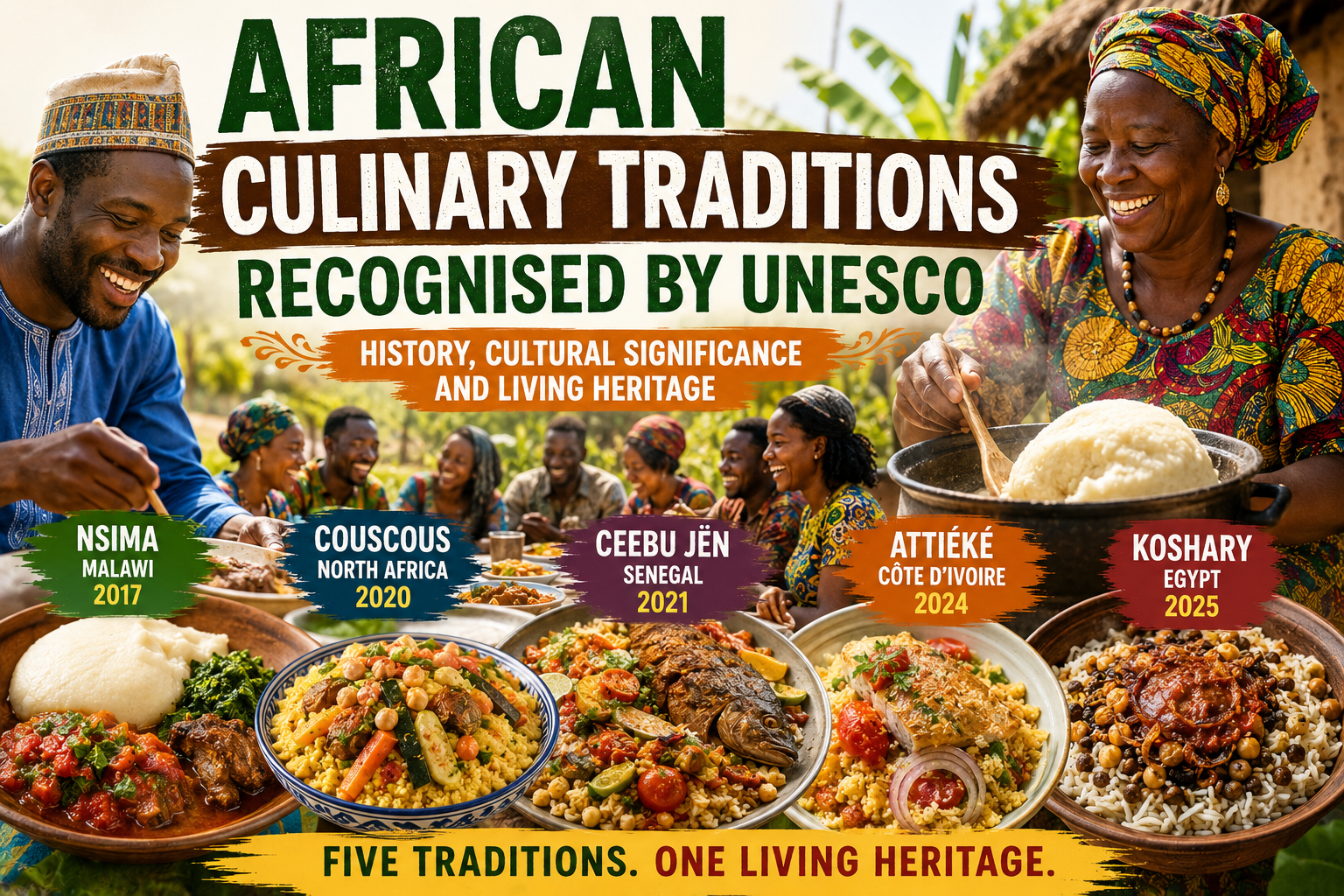
The article examines five prominent African culinary traditions inscribed on UNESCO’s Representative List as of 2026:
- Nsima
- Couscous
- Ceebu Jën
- Attiéké
- Koshary
It also considers the 2003 Convention that makes food heritage recognition possible, the academic evidence supporting the cultural significance of culinary traditions and the future direction of food heritage safeguarding across Africa.
Continued documentation and community-led safeguarding remain important as migration, environmental change and changing patterns of intergenerational transmission affect culinary traditions in different ways.
What UNESCO Recognition Actually Means — and What It Does Not
Before examining which African culinary traditions have been recognised, it is important to clarify what UNESCO recognition actually means.
UNESCO does not recognise a dish merely as a commercial product or certify one fixed recipe as the correct version. Instead, it recognises an element of intangible cultural heritage: a living cultural practice that communities transmit from generation to generation and that provides a sense of identity and continuity.
In relation to food, this may include:
- cultivation and harvesting knowledge;
- preparation and preservation skills;
- utensils and production methods;
- communal eating practices;
- ceremonies and hospitality customs;
- oral traditions;
- songs, gestures and expressions;
- social relationships connected to preparing and sharing food.
UNESCO inscription does not give a country exclusive legal ownership of a culinary tradition. It does not automatically create intellectual property protection, prevent commercial imitation or declare that only one community may prepare a particular food.
Inscription on the Representative List of the Intangible Cultural Heritage of Humanity means that the cultural knowledge, skills, practices and social meanings associated with a tradition have been formally acknowledged internationally.
The inscription raises visibility and encourages safeguarding. It does not necessarily mean that the tradition is endangered.
UNESCO maintains a separate List of Intangible Cultural Heritage in Need of Urgent Safeguarding for cultural practices whose continued viability is seriously threatened. This is distinct from the Representative List.
It is also important to distinguish UNESCO inscription from geographical-indication protection.
UNESCO recognises living cultural practices and knowledge systems. A geographical indication is a legal and commercial mechanism concerning a product’s geographical origin, reputation and production specifications.
For example, Côte d’Ivoire pursued geographical-indication protection for Attiéké through the African Intellectual Property Organization, known as OAPI, in 2024. This process is legally distinct from UNESCO recognition of the knowledge and skills associated with Attiéké production.
The two mechanisms should not be conflated.
Academic scholarship also warns that heritage recognition must remain community-led. If poorly managed, international recognition may freeze, standardise or commercialise traditions that have always adapted to changing community needs.
At its best, inscription supports the people who carry the knowledge rather than treating the product itself as the sole focus of safeguarding.
The 2003 Convention: The Framework That Made Food Heritage Recognition Possible
UNESCO adopted the Convention for the Safeguarding of the Intangible Cultural Heritage on 17 October 2003 during the 32nd session of its General Conference.
The Convention entered into force on 20 April 2006, three months after the deposit of the thirtieth instrument of ratification. It has since been ratified by more than 180 States Parties.
The Convention defines intangible cultural heritage as practices, representations, expressions, knowledge and skills that communities recognise as part of their cultural heritage.
This heritage is transmitted from generation to generation and is continually recreated in response to communities’ environments, histories and interaction with nature.
The Convention recognises that cultural heritage is not limited to monuments, historic buildings or museum collections. It also includes living practices carried by people.
Since the Convention came into force, hundreds of cultural practices from around the world have been inscribed on UNESCO’s heritage lists.
A growing number concern culinary knowledge, food production, farming practices, hospitality and communal eating traditions.
Academic research has found that food plays a major role in forming regional and national identity. Traditional cuisine can carry histories of migration, colonisation, environmental adaptation, faith, farming and exchange.
Research by Rahman, Britwum and Demont (2022) identifies a strong relationship between heritage food and cultural identity, structured around legacy, people and place.
Food therefore operates as more than nourishment. It can function as a record of how communities have survived, adapted and maintained relationships across generations.
Five Prominent African Culinary Traditions Recognised by UNESCO
The following table summarises five prominent African UNESCO inscriptions centred explicitly on named dishes or culinary traditions as of 2026.
Other African practices connected to food, cultivation, drinks, hospitality and agricultural knowledge also appear on UNESCO’s lists. The number identified depends partly on how narrowly culinary heritage is defined.
| Tradition | Country or countries | Year | Principal focus of recognition |
|---|---|---|---|
| Nsima | Malawi | 2017 | Preparation, serving, consumption and communal customs |
| Couscous | Algeria, Mauritania, Morocco and Tunisia | 2020 | Production, preparation, associated knowledge and consumption |
| Ceebu Jën | Senegal | 2021 | Culinary knowledge, social practices and Senegalese identity |
| Attiéké | Côte d’Ivoire | 2024 | Production skills, transmission and community livelihoods |
| Koshary | Egypt | 2025 | Preparation, consumption and associated everyday practices |
Nsima — Malawi, 2017
Nsima, the Culinary Tradition of Malawi, is the UNESCO name for a broad culinary and dietary tradition as well as the name of one of its central foods.
Nsima is a thick porridge usually prepared from maize flour. However, the UNESCO inscription extends beyond the porridge itself.
It includes the knowledge and practices involved in:
- growing maize;
- harvesting and storing it;
- pounding or milling maize into flour;
- preparing the porridge;
- selecting accompanying foods;
- serving the meal;
- following communal mealtime customs.
The preparation of Nsima requires practical knowledge and experience. The texture must be carefully controlled, and the dish is normally served with vegetables, legumes, meat, fish or other accompaniments.
Certain customs regulate behaviour during meals, encouraging cleanliness, sharing and social cohesion.
The process of producing, preparing and eating Nsima is closely connected to Malawian family and community life. Eating together reinforces relationships and provides opportunities for learning and social interaction.
Communities safeguard the tradition through continued practice, festivals, publications, education and community activities.
Knowledge is transmitted informally within households and through observation, participation and practical instruction.
UNESCO’s nomination documentation records that children may begin participating in aspects of preparation from an early age. These descriptions reflect practices documented in the nomination file and should be understood within their historical and community context rather than as fixed expectations for every contemporary Malawian household.
Nsima’s inscription demonstrates that intangible heritage does not have to be rare, elite or ceremonial. Everyday traditions can carry deep cultural value because they structure family relationships, practical knowledge and community identity.
Academic work on women, intangible heritage and development in Africa has also highlighted the significance of social spaces associated with food preparation.
These spaces can be sites of agency, knowledge exchange, creativity and self-expression.
Research by Zhao et al. (2022) further demonstrates that transmitting intangible cultural heritage is a human-centred process through which knowledge, values and skills are passed between generations.
Couscous — Algeria, Mauritania, Morocco and Tunisia, 2020
Couscous has deep roots in Amazigh and wider North African history.
Its precise historical origin remains debated, but archaeological interpretations and written sources show that couscous has been prepared in North Africa for centuries. One of its earliest known written references appears in a thirteenth-century North African cookbook.
Algeria, Mauritania, Morocco and Tunisia submitted a joint nomination in March 2019. UNESCO inscribed the tradition in December 2020.
The joint nomination was especially significant because it represented cross-border cultural cooperation among countries that share a culinary tradition with many regional and family variations.
UNESCO formally inscribed the knowledge, know-how and practices connected to the production and consumption of couscous.
The inscription includes:
- growing and harvesting cereals;
- grinding grain into semolina;
- rolling semolina by hand;
- steaming the grains;
- preparing accompanying vegetables, sauces and meats;
- utensils and preparation tools;
- occasions on which couscous is served;
- social and symbolic meanings attached to sharing it.
Preparing couscous can be an extended process. Semolina is traditionally moistened, rolled by hand and steamed in stages until the desired texture is achieved.
There is no single universal couscous recipe.
Preparation varies according to family traditions, climate, available ingredients, geography and occasion. Coastal, desert, mountain and agricultural communities may use different ingredients and techniques.
This diversity is central to the heritage value of couscous. UNESCO did not inscribe a standardised recipe. It recognised a living and adaptable cultural system.
Women have historically played a central role in preparing couscous and transmitting the knowledge associated with it.
The joint nomination noted that women may transmit not only practical techniques but also songs, gestures, characteristic expressions and forms of ritual organisation connected to preparation.
Couscous can be both an ordinary family meal and a special dish served at weddings, religious celebrations, funerals and community gatherings.
The joint nomination described couscous as ordinary because of its frequent use in households and special because of its unifying role during occasions when food is shared.
Research by Boukid (2025) argues that preserving traditional cereal-based food practices is important for maintaining the cultural richness of North African cuisine while responding to sustainability challenges.
An empirical study involving 517 women across seven regions of north-eastern Algeria found substantial variation in couscous preparation by location, family and community background (Chemache et al., 2018).
These findings reinforce the principle that culinary heritage is diverse, changing and locally interpreted.
Ceebu Jën — Senegal, 2021
Ceebu Jën is a Senegalese culinary tradition associated particularly with the historic fishing communities of Saint-Louis.
In Wolof, Ceebu Jën means rice and fish. It is also widely known internationally as Thiéboudienne.
The dish is typically prepared using fish, broken rice, dried seafood, vegetables and seasonings. Ingredients and methods vary between families and regions.
According to UNESCO, the choice of fish and vegetables may reflect the importance of an occasion or the degree of affection and respect shown to a guest.
A widely repeated oral account attributes the development of Ceebu Jën to Penda Mbaye, a cook associated with Saint-Louis during the nineteenth century.
However, this account should be understood as an important part of oral tradition rather than treated as conclusively proven historical fact.
The cultural heritage associated with Ceebu Jën includes:
- choosing and preparing ingredients;
- culinary techniques;
- communal eating customs;
- hospitality;
- family transmission;
- social rules associated with sharing food;
- Senegalese identity and belonging.
Women have traditionally been the main bearers and practitioners of the tradition, although increasing numbers of men are also involved.
Knowledge is normally transmitted orally and practically from parents and older relatives to younger generations. Children may gradually take on greater responsibilities as their skills develop.
Specific customs are associated with eating Ceebu Jën.
According to the UNESCO nomination documentation, diners should not sit with a raised knee, the shared bowl should be held with the left hand and grains of rice should not be carelessly dropped.
These practices encourage attention, respect and appropriate conduct around the communal meal.
Ceebu Jën therefore represents more than a recipe. It expresses Senegalese ideas about hospitality, dignity, discipline, sharing and belonging.
Research by Tawiah and Aryee (2026) examines the growing international visibility of West African food through migration, diaspora communities and global culinary media.
Within this wider context, Thiéboudienne carries particular significance as a source of Senegalese cultural pride recognised internationally as part of humanity’s intangible heritage.
Research on women’s participation in Senegalese food-processing networks has also shown how food-related knowledge can contribute to income, community networks and social cohesion (O’Brien et al., 2022).
Although that study does not examine Ceebu Jën specifically, it offers useful context concerning women’s economic participation within Senegalese food systems.
Attiéké — Côte d’Ivoire, 2024
Attiéké is a steamed cassava-based food produced particularly by the lagoon peoples of Côte d’Ivoire.
Its production involves several stages:
- cultivating cassava;
- harvesting the tubers;
- peeling and washing them;
- grinding the cassava;
- mixing it with fermented cassava;
- preparing the granules or semolina;
- drying or draining the mixture;
- steaming the finished product.
The process requires specialised knowledge, careful fermentation and practical experience.
Attiéké is traditionally produced by women for household consumption and commercial sale.
According to UNESCO’s documentation, women commonly prepare, cook, preserve and sell Attiéké, while men may be involved in cultivating, harvesting, transporting and grinding cassava.
These divisions reflect documented community practices but should not be regarded as fixed rules that apply to every household or producer.
Knowledge and skills are transmitted orally and through observation, practical participation and family instruction.
The UNESCO inscription gives particular attention to the relationship between Attiéké production and women’s economic autonomy.
For many producers, mastering the process can create income, strengthen social integration and support women-led businesses.
UNESCO’s account of the tradition describes Attiéké as both a cultural practice and an important economic resource for the communities that sustain it.
This makes the inscription especially significant. It shows how safeguarding culinary heritage can contribute to protecting livelihoods as well as cultural knowledge.
Ramata Ly-Bakayoko, Côte d’Ivoire’s representative to UNESCO, has described Attiéké as deeply rooted in community life and as a cultural and economic lifeline for many women producers.
Separately, Côte d’Ivoire pursued geographical-indication protection for Attiéké through OAPI in 2024.
This process concerns the product’s recognised geographical origin and production specifications. It is separate from UNESCO’s recognition of Attiéké production as a living cultural practice.
The distinction matters because UNESCO recognition alone does not prevent commercial imitation or create exclusive ownership rights.
Koshary — Egypt, 2025
Practices associated with Koshary revolve around one of Egypt’s most widely consumed everyday meals.
Koshary is commonly made using:
- rice;
- pasta;
- black lentils;
- fried onions;
- vinegar;
- garlic;
- hot sauce.
Many widely served versions also include chickpeas and tomato sauce. Recipes and serving styles vary between households, street vendors, regions and restaurants.
Koshary is affordable, filling and accessible. It is prepared in homes and sold in restaurants, cafés and street food outlets.
The dish is eaten by people from different ages, social backgrounds and regions of Egypt.
UNESCO’s inscription concerns not only the ingredients but also the knowledge, skills and everyday practices associated with preparing and consuming Koshary.
Knowledge may be transmitted within families, through informal learning, professional culinary training, television programmes and social media.
The tradition is sustained by:
- households;
- street vendors;
- restaurant workers;
- cooks;
- food businesses;
- culinary educators;
- consumers who maintain the custom of eating and sharing the dish.
The nomination documentation identifies mother-to-daughter transmission as one important route through which knowledge has historically been passed within families.
This reflects documented transmission patterns and should not be interpreted as limiting the tradition to women or prescribing fixed roles within contemporary Egyptian households.
Koshary promotes a shared identity because it is widely available and consumed across social divisions.
Its cultural significance lies partly in its ordinariness. It is not restricted to elite restaurants or ceremonial occasions. It forms part of daily urban and family life.
Koshary became Egypt’s first UNESCO inscription centred explicitly on a named dish and associated practices. It was also the country’s eleventh element on UNESCO’s intangible heritage lists.
Egyptian Minister of Culture Ahmed Fouad Hanno described Koshary as an integral part of Egyptian identity.
Its inscription reflects growing international recognition that accessible, affordable and everyday food practices can carry irreplaceable heritage value.
The Significance of These Traditions for African Diaspora Communities in the UK
For African heritage communities living in Britain, UNESCO recognition has significance beyond international heritage policy.
Food traditions are among the most persistent and emotionally significant ways in which people maintain connections with family history, language, identity and place after migration.
A peer-reviewed study published in Nutrients examined cultural influences on the dietary behaviour of African migrant women in the UK.
The study found that cultural and environmental factors substantially affected participants’ experiences of food after migration.
Important themes included:
- food rituals and beliefs;
- the cultural meaning of meals;
- difficulty accessing culturally appropriate ingredients;
- changes in family eating practices;
- the importance of food to cultural identity.
These findings demonstrate that disrupted access to ingredients and culinary knowledge can have consequences for cultural continuity as well as diet and health (Ngongalah et al., 2023).
Food may also help people create connections between their country of origin and the society in which they now live.
Research by Arcadu et al. (2025) found that food in a migration context can operate not only as a means of preserving identity but also as a shared project capable of creating meaningful relationships with host communities.
Food practices can therefore help people navigate complex identities rather than forcing them to choose between one culture and another.
Heritage food can also challenge stereotypes. Community meals, exhibitions, cooking workshops and oral-history projects allow African communities to present their own knowledge and experiences directly.
This creates opportunities for cultural learning while avoiding the reduction of African food to entertainment, novelty or commercial branding.
Lived Experiences from the Enfield African Heritage Food Project
Anonymised oral-history interviews undertaken by the Enfield African Heritage Food Project between June 2025 and May 2026 provide direct evidence of the role of food in African diaspora life.
The interviews involved approximately 20 contributors and were conducted with informed participant consent. Records are held by Diversity Rights and were collected for public educational and heritage purposes.
Participants frequently described heritage food as a source of:
- memory;
- family connection;
- cultural identity;
- belonging;
- continuity between generations.
Several contributors recalled learning to prepare traditional foods by watching parents, grandparents and other relatives rather than using written recipes.
This method of learning required observation, repetition and practical involvement.
Some contributors explained that preparing traditional dishes in Britain helped younger family members understand places and relatives they had never visited.
A meal could therefore become an opportunity to discuss migration, childhood, family history, farming, language and community life.
These lived experiences show that food is not merely nutrition.
Within diaspora households, it can be a primary site where oral tradition, cultural memory and intergenerational identity formation occur simultaneously.
The interviews also reveal practical challenges.
Families may find that ingredients taste different in Britain, traditional equipment is unavailable or younger people have less time to learn complex preparation methods.
Some traditions may therefore be adapted to new ingredients, technologies and household routines.
This does not necessarily mean that the heritage has been lost. Intangible cultural heritage is continually recreated as communities respond to new circumstances.
Challenges, Opportunities and Future Trends
Challenges
Only a relatively small number of UNESCO inscriptions are centred explicitly on named African dishes or culinary traditions.
However, Africa possesses thousands of food-related practices that remain undocumented or absent from international heritage lists.
These include:
- fermentation techniques;
- bread-making traditions;
- coffee ceremonies;
- agricultural knowledge;
- date-palm cultivation;
- food preservation;
- communal hospitality;
- indigenous seed knowledge;
- fishing practices;
- ceremonial meals;
- food traditions shared across borders.
One challenge is unequal institutional capacity.
Countries with specialist heritage agencies, experienced researchers and stronger documentation resources may be better positioned to prepare UNESCO nomination files.
Communities in countries with limited resources may face practical disadvantages, even where their traditions have substantial historical and cultural importance.
Other challenges include:
- ageing heritage practitioners;
- weakening intergenerational transmission;
- migration and displacement;
- climate change;
- loss of traditional crops;
- changing land-use systems;
- commercial appropriation;
- standardisation of diverse recipes;
- economic benefits failing to reach tradition-bearers.
Climate pressure is particularly important.
Changes in rainfall, soil conditions, water availability and biodiversity may affect crops, fish stocks and wild ingredients that support culinary traditions.
Commercial interest also presents risks.
International recognition may increase demand for particular foods, but businesses outside the communities concerned may capture much of the economic value.
Communities may find their heritage marketed globally while local producers receive limited recognition or financial benefit.
A systematic review by Ongori et al. (2023) noted growing interest in the relationship between cultural heritage, community development, health and wellbeing, although these areas remain under-represented in heritage research.
This research gap reinforces the value of community-led documentation initiatives such as the Enfield African Heritage Food Project.
Opportunities
UNESCO is developing an International Food Atlas and Digital Platform in collaboration with participating countries, experts and communities.
The project supports the documentation, safeguarding, promotion and transmission of foodways as living heritage.
It may strengthen international understanding of how food practices connect communities to land, identity, environment and history.
UNESCO recognition can also create opportunities for:
- cultural education;
- skills training;
- ethical tourism;
- food enterprises;
- women-led businesses;
- community archives;
- youth engagement;
- international cultural exchange.
However, these benefits are not automatic.
Communities need clear governance arrangements to ensure that economic and reputational benefits are shared fairly.
Heritage safeguarding should prioritise the interests of tradition-bearers rather than external organisations seeking to exploit a recognised cultural name.
Community-led oral-history projects provide one practical opportunity.
Interviews can document memories, techniques, local terminology, songs, beliefs and preparation methods that may not exist in written records.
Schools and youth projects can also support transmission through cooking activities, storytelling, exhibitions and digital resources.
Diaspora communities have an important role to play. They can document how traditions are adapted after migration and how food supports cultural identity in new environments.
Digital archives and instructional recordings may help preserve knowledge while making it accessible to younger generations.
Cross-border nominations are another important opportunity.
Many African food traditions predate modern national boundaries and are shared across linguistic, ecological and ethnic regions.
The joint couscous nomination demonstrates how countries can cooperate rather than compete over a shared cultural tradition.
Future Trends
Future nominations may increasingly involve food traditions shared across several countries.
This is especially likely where communities, farming systems and ecological regions extend beyond modern political borders.
UNESCO’s current safeguarding work indicates growing attention to:
- community participation;
- environmental sustainability;
- digital documentation;
- cultural transmission;
- climate resilience;
- economic justice;
- the rights and wellbeing of tradition-bearers.
Diaspora communities may also become more visible within safeguarding initiatives.
Migration does not automatically end cultural transmission. It can create new forms of adaptation, documentation and exchange.
African communities in Britain and elsewhere are already preserving food heritage through:
- family teaching;
- community festivals;
- restaurants;
- cultural organisations;
- social media;
- oral-history interviews;
- cooking demonstrations;
- educational videos.
The future of African culinary heritage is therefore likely to involve both local continuity and global adaptation.
The central question will not simply be whether traditions survive. It will be whether communities retain meaningful control over how their knowledge is represented, transmitted and commercialised.
Conclusion
The UNESCO recognition of Nsima, Couscous, Ceebu Jën, Attiéké and Koshary demonstrates that culinary heritage extends far beyond ingredients and recipes.
It encompasses:
- knowledge of cultivation and processing;
- preparation and preservation skills;
- social customs;
- family relationships;
- hospitality;
- memory;
- identity;
- methods of intergenerational transmission.
These traditions show that everyday food practices can carry profound cultural significance.
For African communities and the diaspora, safeguarding culinary heritage requires more than international recognition.
It requires:
- oral-history documentation;
- intergenerational learning;
- community leadership;
- environmental resilience;
- fair economic opportunities;
- respect for the people who practise and transmit the heritage.
The Enfield African Heritage Food Project contributes to this work by documenting community knowledge and helping younger generations encounter African culinary traditions as living heritage rather than isolated dishes.
International recognition can raise visibility, but the future of these traditions ultimately depends on communities having the resources, authority and opportunity to keep practising, adapting and teaching them.
Frequently Asked Questions
Does UNESCO recognise dishes or cultural practices?
UNESCO recognises the living cultural practices associated with culinary traditions, including knowledge, skills, preparation methods, communal rituals and social meanings. It does not certify a dish merely as a commercial product or prescribe one authoritative recipe.
How can an African culinary tradition be nominated for UNESCO recognition?
A State Party to the 2003 Convention must normally include the tradition in a national heritage inventory, prepare a nomination dossier, demonstrate that the nomination satisfies UNESCO’s criteria, secure the free, prior and informed consent of the communities concerned and submit the nomination through the relevant national authorities.
The full process can take several years.
Does UNESCO recognition give a country exclusive ownership of a dish?
No. UNESCO inscription does not grant exclusive ownership of a culinary tradition.
It also does not automatically create intellectual property rights or legal protection against commercial imitation.
The inscription recognises the associated living cultural practices as part of humanity’s shared cultural heritage.
Why are relatively few African culinary traditions represented on UNESCO’s lists?
Preparing a UNESCO nomination requires research, documentation, community consultation, specialist knowledge and institutional capacity.
Countries with stronger heritage institutions may be better positioned to prepare successful nominations.
As a result, many culturally important African food traditions may remain undocumented or absent from international lists.
Can diaspora communities help safeguard African food heritage?
Yes. Diaspora communities can contribute through oral-history projects, digital archives, cooking programmes, cultural events, intergenerational teaching and documentation of how traditions adapt after migration.
These activities can strengthen cultural continuity and help younger generations understand their heritage.
What is the difference between UNESCO recognition and a geographical indication?
UNESCO inscription recognises a living cultural practice.
A geographical indication is a legal and commercial mechanism concerning a product associated with a particular geographical origin, reputation or production method.
These mechanisms serve different purposes and operate through separate legal and institutional frameworks.
References
Al Jazeera (2020) ‘UNESCO adds couscous to list of intangible world heritage’, Al Jazeera, 16 December. Available at: https://www.aljazeera.com/news/2020/12/16/unesco-adds-couscous-traditions-to-intangible-cultural-heritage-list (Accessed: 12 July 2026).
Arcadu, M., Tubertini, E., Reyes Espejo, M.I. and Migliorini, L. (2025) ‘Identity construction and community building practices through food: a case study’, Behavioural Sciences, 15(12), Article 1675. Available at: https://doi.org/10.3390/bs15121675 (Accessed: 12 July 2026).
Boukid, F. (2025) ‘Traditional cereal-based foods in North African cuisine: wheat as the cornerstone’, North African Journal of Food and Nutrition Research, 9(19), pp. 41–56. Available at: https://doi.org/10.51745/najfnr.9.19.41-56 (Accessed: 12 July 2026).
Chemache, L., Kehal, F., Namoune, H., Chaalal, M. and Gagaoua, M. (2018) ‘Couscous: ethnic making and consumption patterns in the northeast of Algeria’, Journal of Ethnic Foods, 5(3), pp. 211–219. Available at: https://doi.org/10.1016/j.jef.2018.08.002 (Accessed: 12 July 2026).
Daily News Egypt (2025) ‘UNESCO adds Egypt’s national dish Koshary to intangible cultural heritage list’, Daily News Egypt, 10 December. Available at: https://www.dailynewsegypt.com/2025/12/10/unesco-adds-egypts-national-dish-koshary-to-intangible-cultural-heritage-list/ (Accessed: 12 July 2026).
Diversity Rights (2025) Enfield African Heritage Food Project. London: Diversity Rights. Available at: https://www.diversityrights.org.uk/african-heritage-food-project/ (Accessed: 12 July 2026).
Ngongalah, L., Rapley, T., Rankin, J. and Heslehurst, N. (2023) ‘Cultural influences on African migrant pregnant and postnatal women’s dietary behaviours and nutrition support needs in the UK’, Nutrients, 15(19), Article 4135. Available at: https://doi.org/10.3390/nu15194135 (Accessed: 12 July 2026).
O’Brien, C., Leavens, L., Ndiaye, C. and Traoré, D. (2022) ‘Women’s empowerment, income, and nutrition in a food processing value chain development project in Touba, Senegal’, International Journal of Environmental Research and Public Health, 19(15), Article 9526. Available at: https://doi.org/10.3390/ijerph19159526 (Accessed: 12 July 2026).
OAPI (Organisation Africaine de la Propriété Intellectuelle) (2024) Geographical indications: Attiéké des Lagunes, Côte d’Ivoire. Yaoundé: OAPI. Available at: https://ig-oapi.org/en/ (Accessed: 12 July 2026).
Ongori, J.M. et al. (2023) ‘Exploring the relationships between heritage tourism, sustainable community development and host communities’ health and wellbeing: a systematic review’, PLOS ONE. Available at: https://doi.org/10.1371/journal.pone.0282319 (Accessed: 12 July 2026).
Rahman, M., Britwum, K. and Demont, M. (2022) ‘Food security and the cultural heritage missing link’, Current Research in Food Science, 5, pp. 1591–1600. Available at: https://doi.org/10.1016/j.crfs.2022.09.006 (Accessed: 12 July 2026).
Tawiah, N.A. and Aryee, A.N.A. (2026) ‘West African culinary globalization in contemporary America’, Encyclopedia, 6(6), Article 133. Available at: https://doi.org/10.3390/encyclopedia6060133 (Accessed: 12 July 2026).
UNESCO (2003) Convention for the Safeguarding of the Intangible Cultural Heritage. Paris: UNESCO. Available at: https://ich.unesco.org/en/convention (Accessed: 12 July 2026).
UNESCO (2006) Brief history of the Convention for the Safeguarding of the Intangible Cultural Heritage. Paris: UNESCO. Available at: https://ich.unesco.org/en/brief-history-00093 (Accessed: 12 July 2026).
UNESCO (2017) Nsima, culinary tradition of Malawi. Representative List of the Intangible Cultural Heritage of Humanity. Paris: UNESCO. Available at: https://ich.unesco.org/en/RL/nsima-culinary-tradition-of-malawi-01292 (Accessed: 12 July 2026).
UNESCO (2020a) Knowledge, know-how and practices pertaining to the production and consumption of couscous. Representative List of the Intangible Cultural Heritage of Humanity. Paris: UNESCO. Available at: https://ich.unesco.org/en/RL/knowledge-know-how-and-practices-pertaining-to-the-production-and-consumption-of-couscous-01602 (Accessed: 12 July 2026).
UNESCO (2020b) ‘UNESCO’s inscription of couscous traditions: an example of international cultural cooperation’. Paris: UNESCO. Available at: https://www.unesco.org/en/articles/unescos-inscription-couscous-traditions-example-international-cultural-cooperation (Accessed: 12 July 2026).
UNESCO (2021a) Ceebu Jën, a culinary art of Senegal. Representative List of the Intangible Cultural Heritage of Humanity. Paris: UNESCO. Available at: https://ich.unesco.org/en/RL/ceebu-jn-a-culinary-art-of-senegal-01748 (Accessed: 12 July 2026).
UNESCO (2021b) Decision of the Intergovernmental Committee: 16.COM 8.b.36. Paris: UNESCO. Available at: https://ich.unesco.org/en/Decisions/16.COM/8.b.36 (Accessed: 12 July 2026).
UNESCO (2024a) Skills related to Attiéké production in Côte d’Ivoire. Representative List of the Intangible Cultural Heritage of Humanity. Paris: UNESCO. Available at: https://ich.unesco.org/en/RL/skills-related-to-attieke-production-in-cote-d-ivoire-02086 (Accessed: 12 July 2026).
UNESCO (2024b) Foodways: growing recognition and reinforced safeguarding measures. Paris: UNESCO. Available at: https://ich.unesco.org/en/news/foodways-growing-recognition-and-reinforced-safeguarding-measures-13541 (Accessed: 12 July 2026).
UNESCO (2025) Koshary, daily life dish and practices associated with it. Representative List of the Intangible Cultural Heritage of Humanity. Paris: UNESCO. Available at: https://ich.unesco.org/en/RL/koshary-daily-life-dish-and-practices-associated-with-it-02278 (Accessed: 12 July 2026).
UNESCO (2026) International Food Atlas and digital platform for safeguarding, promoting and transmitting foodways to future generations. Paris: UNESCO. Available at: https://www.unesco.org/en/culture-and-digital-technologies/international-food-atlas (Accessed: 12 July 2026).
Zhao, J., Wang, Z., Wang, C., Han, L., Ruan, Y., Huangfu, Z., Zhou, S. and Zhou, L. (2022) ‘Research on the status of intangible cultural heritage bearers in the human capital perspective’, Frontiers in Psychology, 13, Article 850780. Available at: https://doi.org/10.3389/fpsyg.2022.850780 (Accessed: 12 July 2026).
UK African Heritage Food Project | Diversity Rights